
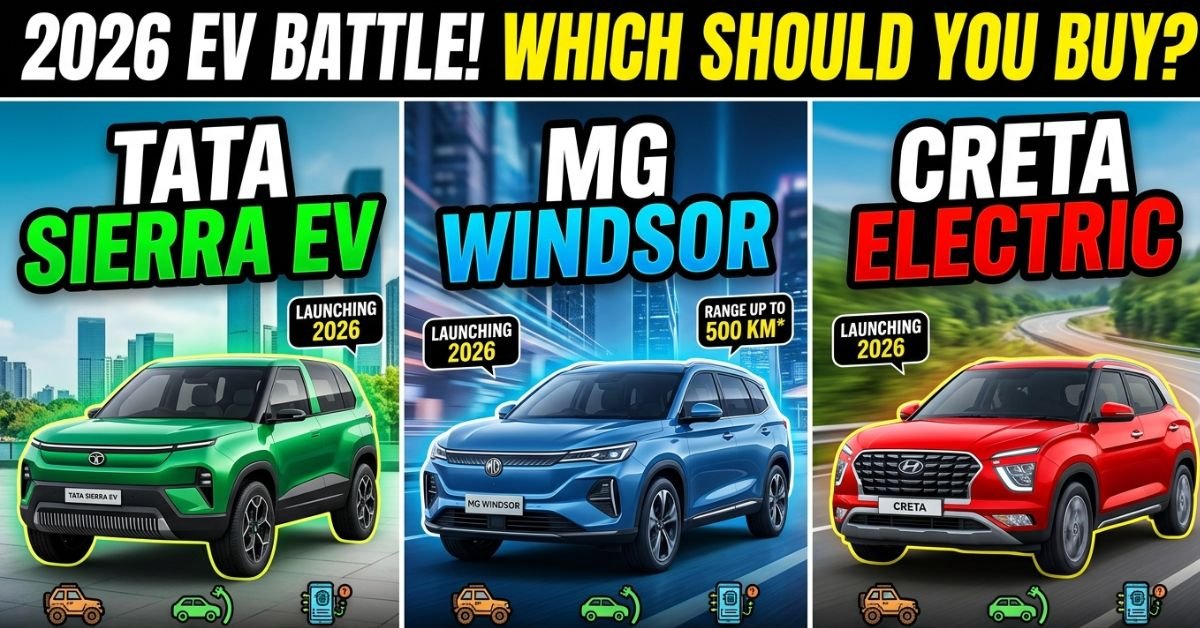
The Indian EV market in 2026 has never offered buyers more genuinely good choices, and nowhere is that more true than in the ₹14 lakh to ₹25 lakh electric SUV space. Three names dominate almost every showroom conversation right now: the crowd-favourite MG Windsor EV, the tried-and-trusted Hyundai Creta Electric, and the highly anticipated Tata Sierra EV, which is on the verge of launching between July and September 2026.
Each of these cars tells a different story. The Windsor is a value-focused disruptor that became India’s best-selling EV of 2025. The Creta Electric is the safe, sensible, feature-loaded choice from a brand Indians already trust. And the Sierra EV? It’s Tata’s boldest bet yet, a nostalgia-soaked, high-spec electric SUV that could shake up the segment entirely when it finally arrives.
This is not a spec-sheet comparison. This is a buyer’s guide to help you figure out which one is actually right for you.
Quick Snapshot: Where Each Car Stands
| MG Windsor EV | Hyundai Creta Electric | Tata Sierra EV | |
|---|---|---|---|
| Price (Ex-showroom) | ₹14 – ₹18.5 lakh | ₹18.02 – ₹23.82 lakh | ₹20 – ₹28 lakh (expected) |
| Battery Options | 38 kWh / 52.9 kWh | 42 kWh / 51.4 kWh | 55 kWh / 65 kWh (expected) |
| Claimed Range | 331 km / 449 km | 390 km / 473 km | 500 – 600+ km (expected) |
| Motor Output | 136 hp / 200 Nm | 135–171 hp | ~167 hp (FWD) / AWD option |
| Fast Charging | 60 kW DC | 50 kW DC | 100 kW DC (expected) |
| ADAS Level | Level 2 (Pro only) | Level 2 (Long Range) | Level 2+ |
| Launch Status | On Sale Now | On Sale Now | July–Sept 2026 |
Design: Who Turns Heads on Indian Roads?
MG Windsor EV
The Windsor is a deliberately polarising car. Its mono-volume silhouette — somewhere between an MPV, a crossover, and a hatchback, is unlike anything else on Indian roads. Some love it for being different; others find it too MPV-like for SUV money.
What nobody disputes is that the 15.6-inch portrait-style touchscreen dominating the dashboard is genuinely dramatic, and the 135-degree reclining rear “aero lounge” seats are a conversation starter every single time. The connected LED lighting up front and flush door handles give it a premium-tech aesthetic that punches well above its price.
Hyundai Creta Electric
The Creta Electric plays it safe with design, and that’s not an insult. Hyundai has done just enough to differentiate it from the petrol Creta: a closed pixelated grille, aero alloy wheels, and subtle EV-specific accents. It’s clean, modern, and widely appealing. The dual 10.25-inch side-by-side screen setup inside is impressive, and the cabin quality feels refined and well put-together. If you already love the Creta’s design language, the EV version gives you more of it. If you were hoping for a dramatic rethink, you won’t find it here.
Tata Sierra EV
This is where things get exciting. Tata has stayed remarkably true to the iconic “glass house” design of the original Sierra — the rear three-quarter glass, the boxy silhouette, the nostalgia-inducing proportions — while wrapping all of it in thoroughly modern 2026 detailing. Triple-screen dashboard. A flat floor thanks to the Acti.ev platform. First-in-segment “Lounge” seating configuration for rear passengers. On design alone, the Sierra EV may be the most head-turning electric SUV India has seen since the Harrier EV.
Winner on Design: Tata Sierra EV — but if you want something available right now, the Windsor EV is the most distinctive choice.
Range and Battery: The Numbers That Matter Most
Real-world range anxiety is still one of the top concerns for Indian EV buyers, especially for those in cities with limited home charging options. EV resale value concerns or long-term ownership costs.
The MG Windsor EV’s base 38 kWh pack gives a claimed 331 km, which translates to a realistic 240–270 km in mixed city/highway driving. That’s adequate for daily urban commuting but may make you nervous on longer highway runs. The 52.9 kWh Pro variant claims 449 km (realistic ~340–370 km) and is a much more practical all-rounder.
It’s worth noting that MG also offers a Battery-as-a-Service (BaaS) model, where you can purchase the car at a lower upfront cost and pay a monthly rental for the battery — an interesting option for buyers who are worried about long-term battery degradation.
The Hyundai Creta Electric is available in two battery configurations: 42 kWh (claimed 390 km, ~300 km real-world) and 51.4 kWh Long Range (claimed 473 km, ~360–400 km real-world).
The Long Range variant is genuinely highway-capable and reduces charging stops on intercity routes significantly. The 50 kW DC fast charging capability means you can add around 80–100 km in about 30 minutes at a public fast charger, which is usable but not class-leading.
The Tata Sierra EV, if the expected specifications hold- will be the range champion of this group. With a 65 kWh battery expected to deliver a certified 500+ km ARAI range and a realistic 400–450 km in real-world conditions, it will comfortably outpace both rivals.
The addition of 100 kW DC fast charging also means quicker highway top-ups. Bidirectional charging (V2L and V2V) means the Sierra EV can power appliances or even charge another EV from its battery, a genuinely useful real-world feature.
Winner on Range: Tata Sierra EV, but since it isn’t out yet, the Hyundai Creta Electric Long Range is the best available option today.
Features and Technology: What Do You Get for the Money?
MG Windsor EV
The Windsor punches well above its price on features. The 15.6-inch touchscreen with wireless Android Auto and Apple CarPlay is the largest in its segment.
The Infinity panoramic glass roof, 256-colour ambient lighting, and ventilated front seats on the Pro variant are genuinely premium touches. Level 2 ADAS is reserved for the top-spec Essence Pro, which is a fair criticism, you have to spend ₹18+ lakh to get safety assist features that the Creta Electric offers at lower trims.
Hyundai Creta Electric
The Creta EV sets a high bar for technology at this price point. The twin 10.25-inch display setup is impressive, and the navigation system is EV-optimised, it shows real-time charger availability and calculates range-aware routes.
Level 2 ADAS includes Highway Driving Assist (HDA), which combines lane centring and adaptive cruise control on expressways, a genuine fatigue-reducer for long highway drives. The BOSE 8-speaker audio on top-spec trims is legitimately excellent. Hyundai’s connected car tech (BlueLink) is also mature and reliable.
Tata Sierra EV
Tata’s tech spec list reads like a premium EV wishlist: a triple-screen dashboard (12.3-inch infotainment + 12.3-inch instrument cluster + 12.3-inch front passenger display), Level 2+ ADAS, OTA software updates, 360-degree surround-view camera, and V2L/V2V bidirectional charging. If these features make it to production at the expected price, the Sierra EV will be the most technologically loaded car in this group by a significant margin.
Winner on Features: Tata Sierra EV (expected) — Hyundai Creta Electric wins among cars you can buy today.
Practicality: The Real-World Test
For Indian families, practicality often trumps everything else.
The Hyundai Creta Electric scores well here. The 433-litre boot is class-leading (possible because the battery sits under the floor, not in the boot area), ground clearance is 200 mm, and the cabin is genuinely spacious. It’s a five-seater SUV that does all the familiar Creta things but with electric power.
The MG Windsor EV offers the widest cabin thanks to its mono-volume body, and those reclining rear seats make it a brilliant long-journey car. Boot space (604 litres) is actually the best in this group by a wide margin. However, the low ground clearance (186 mm) and MPV-style proportions may be a concern for buyers who frequently drive on rougher roads or semi-urban terrain.
The Tata Sierra EV’s flat floor (enabled by the Acti.ev platform) promises exceptional rear passenger space, and the AWD option means it will be capable on highways and varied terrain. The “Lounge” seating mode for rear passengers is a class first.
Winner on Practicality: MG Windsor EV (boot space + rear comfort) for urban families; Hyundai Creta Electric for all-round daily usability.
Price and Value: Where Does Each Car Make Sense?
This is the most important factor for most Indian buyers, so let’s be direct about it.
MG Windsor EV (₹14 – ₹18.5 lakh) is the clear value leader. For under ₹15 lakh, you’re getting a feature-packed electric CUV that became India’s best-selling EV of 2025 for a reason. The BaaS model further reduces upfront costs. If budget is the primary concern, the Windsor is hard to argue against. The caveat: the base 38 kWh variant’s range may feel limiting if you drive more than 80–100 km daily.
Hyundai Creta Electric (₹18.02 – ₹23.82 lakh) sits in the mid-range. You’re paying a premium over the Windsor, but you’re getting a more complete all-round package – better brand trust, stronger after-sales network, superior long-range capability (on the LR variant), and more mature technology integration. For buyers who want reliability and don’t want to compromise on range, the Creta Electric Long Range at around ₹20–22 lakh is a very sweet spot. Chery Jaecoo J5 is also being positioned as a Creta Electric rival
Tata Sierra EV (Expected ₹20 – ₹28 lakh) will ask you to pay premium-adjacent money, but potentially deliver premium-adjacent specs, especially on range, ADAS, and design. The big risk? It’s not available yet, pricing may shift, and early batches of a new car always carry some production uncertainty.
Winner on Value Right Now: MG Windsor EV – but the Creta Electric wins on overall value proposition when range, brand, and after-sales are weighted together.
After-Sales and Service Network
This is often overlooked in comparison articles, but matters enormously in India.
Hyundai has one of the most extensive service networks in the country, with dealerships in virtually every city and town. EV-trained technicians and spare parts availability are well-established.
Tata Motors isn’t far behind, particularly for EVs. Tata has heavily invested in its EV service infrastructure and is the dominant force in the Indian EV market.
MG Motor (now JSW MG) has grown its network rapidly, but still lags behind Hyundai and Tata in tier-2 and tier-3 city coverage. This is worth factoring in if you’re not in a major metro.
Winner on After-Sales: Hyundai Creta Electric
Who Should Buy Which Car?
Buy the MG Windsor EV if:
- Your budget is under ₹17 lakh
- You primarily drive within the city and don’t do frequent long highway runs
- You want maximum features for the money
- The BaaS model appeals to you as a way to reduce upfront cost
Buy the Hyundai Creta Electric if:
- You want a proven, reliable all-rounder from a trusted brand
- You do regular intercity drives (the Long Range variant is genuinely highway-friendly)
- After-sales peace of mind is non-negotiable
- You want the best safety assist system among cars you can buy today
Wait for the Tata Sierra EV if:
- Design and style matter to you as much as specs
- You need the longest real-world range possible
- AWD capability is on your wishlist
- You’re planning to buy later in 2026 anyway, and a few months’ wait won’t hurt
The Verdict
There’s no single “best” car here, and that’s actually a great sign for Indian EV buyers.
The MG Windsor EV is the accessible, feature-rich gateway into EV ownership. The Hyundai Creta Electric is the most complete package you can drive home today. And the Tata Sierra EV, if it delivers on its considerable promise when it launches in July–September 2026, could be the most compelling electric SUV India has seen at this price point.
If you’re ready to buy right now, the Hyundai Creta Electric Long Range at ₹20–22 lakh is our pick for the best overall package. But if you can wait three to four months, and we think most buyers considering a car at this price point can, the Sierra EV deserves serious attention before you sign on the dotted line.