
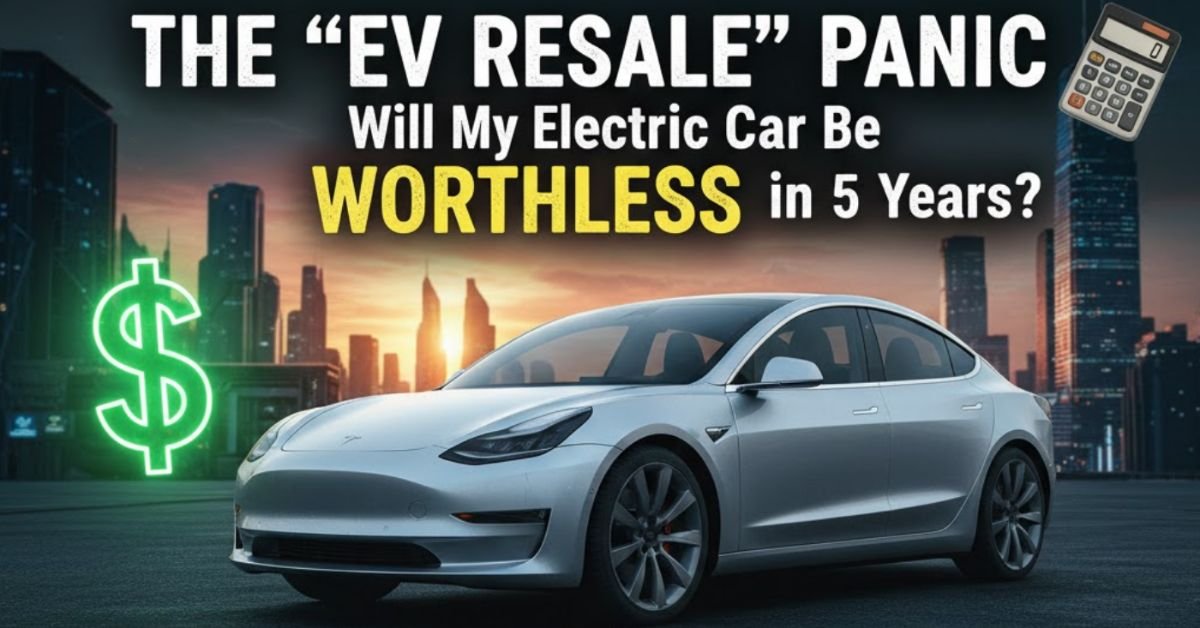
For all the progress electric vehicles have made by 2026, one concern continues to dominate buyer conversations: resale value. I hear it constantly, “What if my EV becomes obsolete?” or “Will it be worth anything in five years?”
This fear isn’t baseless. Between 2023 and 2025, early EV adopters watched resale values swing dramatically as newer models arrived with better range, faster charging, and improved battery chemistry. That created a perception that EVs depreciate faster than petrol or hybrid cars.
But here’s the reality: the situation in 2026 is more stable, more predictable—and far less dramatic than the panic suggests.
Why EV Depreciation Became a Hot Topic
To understand today’s market, you need to understand what went wrong earlier.
In the early growth phase of EV adoption, technology was evolving at an unusually fast pace. Battery energy density improved, charging speeds increased, and costs dropped quickly. This meant that a three-year-old EV could suddenly look outdated compared to a new one offering 30–40% more range at a similar price.
From a financial perspective, that created accelerated depreciation, not because EVs were unreliable, but because they were improving too fast.
At the same time, the used EV market was still immature. Buyers were unsure how to evaluate battery health, and there was limited data on long-term degradation. Naturally, this uncertainty pushed resale prices down.
What’s Changed in 2026?
The EV market has matured significantly.
Battery technology is no longer making massive year-on-year leaps. Improvements are now incremental rather than revolutionary. In my recent testing of 2026 models, the difference between a two-year-old EV and a new one is noticeable—but not drastic enough to make the older car feel obsolete.
More importantly, battery degradation data is now widely available. Most modern EV batteries lose around 8–12% capacity over five years, which is far less dramatic than many early fears suggested. This has helped build confidence in the used EV market.
Insurance companies and lenders have also adjusted. I’ve noticed that financing and insurance premiums for EVs have stabilized, which is a strong indicator that the industry now sees them as predictable assets rather than risky bets.
The Real Factors That Affect EV Resale Value
Not all EVs depreciate the same way. Several key factors determine how well your car will hold its value.
Battery Health (The Biggest Driver)
The battery is the single most important component in an EV. Buyers in the used market care less about mileage and more about remaining battery capacity, usually measured as a percentage.
A well-maintained battery with 90% health after five years will command a significantly higher resale price than one that has degraded more aggressively.
Brand and Software Support
In 2026, EVs are as much software products as they are mechanical machines. Vehicles that receive regular software updates—improving efficiency, adding features, or optimising battery usage—tend to age better.
Cars from brands with strong service networks and consistent updates hold value more effectively because buyers trust their long-term support.
Charging Speed and Infrastructure Compatibility
Older EVs with slower charging capabilities are more likely to depreciate faster. As public fast-charging infrastructure improves, buyers increasingly prioritise vehicles that can take advantage of it.
An EV that charges quickly and supports modern standards remains relevant longer.
The Truth About 5-Year EV Depreciation
Let’s address the core question directly: Will your EV be worthless in five years?
In 2026, most EVs retain around 40–50% of their original value after five years. That’s slightly lower than petrol cars, which typically hold 50–55%, and hybrids, which can reach 55–60%.
The difference isn’t catastrophic—it’s a matter of margin, not collapse.
What I’ve observed in recent resale trends is that EV depreciation is front-loaded. The biggest drop happens in the first two to three years, after which values stabilise. This is similar to luxury cars, where early depreciation is steep but then levels out.
Hidden Advantage: Lower Running Costs Offset Depreciation
One critical point often missing from the resale debate is the role of running costs. Even if an EV depreciates slightly more than a petrol car, it saves a significant amount in fuel over five years. For a typical driver covering 15,000 km annually, the difference in energy cost alone can exceed ₹3–4 lakh over five years.
In practical terms, this means that a slightly lower resale value is often offset by the savings you’ve already realized during ownership. From a total cost perspective, depreciation cannot be viewed in isolation, it has to be considered alongside running costs.
Where EVs Still Struggle
Despite improvements, there are still genuine concerns that buyers should not ignore.
The first is uncertainty around future technology shifts. While progress has slowed, breakthroughs in solid-state batteries or ultra-fast charging could still impact older models.
The second is public perception. In many markets, including parts of India, used EV buyers remain cautious. This affects liquidity—the ease with which you can sell your car—more than the actual price.
Finally, battery replacement costs, although rare within five years, remain a psychological barrier. Even if warranties cover most issues, the fear of a high replacement cost influences resale demand.
Petrol vs. Hybrid vs. EV: Resale Reality Check
When comparing all three powertrains, the hierarchy in 2026 is clear:
Hybrids offer the most stable resale value due to their balanced appeal and lack of dependency on charging infrastructure. Petrol cars remain predictable, supported by widespread familiarity and demand.
EVs, while improving, still carry a slight depreciation premium due to evolving technology and buyer perception. However, the gap is narrowing. What was once a major disadvantage for EVs has become a manageable trade-off.
Final Verdict: Should You Worry About EV Resale?
After analysing market trends and real-world ownership data, my conclusion is straightforward: the “EV resale panic” is largely exaggerated in 2026.
Yes, EVs may depreciate slightly more than petrol or hybrid cars. But they are far from becoming worthless. In fact, as the ecosystem matures, its resale performance is becoming increasingly predictable.
If your buying decision is based purely on resale value, a hybrid is still the safest choice. But if you’re considering total ownership cost, daily running expenses, and long-term usability, EVs remain a financially viable option.
The smarter way to think about it is this:
- An EV is not a risky asset anymore—it’s simply a different kind of asset.
And like any asset, its value depends on how well it fits your usage, your infrastructure access, and your expectations over time.
In 2026, the question is no longer whether an EV will hold value—it’s whether you understand how that value is created.